
Non-surgical skin tightening is now one of the most common requests in aesthetic medicine. Faced with the gradual sagging of tissues due to aging, weight fluctuations, or pregnancy, patients are seeking effective, minimally invasive solutions with a quick recovery time. It is in this context that Endolift® and Renuvion® have established themselves as two leading options. These two technologies are based on very different mechanisms of action. Choosing between Endolift and Renuvion is therefore not something to be taken lightly.
In this article, you'll learn how these devices work, in which situations each is preferable, and why using them in combination offers promising prospects for optimizing results in skin rejuvenation.
Endolift vs. Renuvion: Understand the Difference in 1 Minute
More and more cosmetic surgeons are turning to non-surgical skin tightening treatments. Endolift® and Renuvion® (J-Plasma) are among the most advanced devices available today. Although these two technologies share the same goal— to combat skin laxity —they rely on fundamentally different mechanisms of action. Understanding the differences between Endolift and Renuvion is essential for properly guiding patients and achieving the best results.
Subdermal Laser vs. RF Plasma: Two Very Different Technologies
Endolift® uses a 1,470-nm diode laser delivered via microfibers inserted under the skin. This wavelength specifically targets the water contained in the subdermal tissues. It then induces a controlled thermal lesion that stimulates collagen remodeling. The fiber is inserted parallel to the skin’s surface into the subdermal layer, using back-and-forth movements to mechanically stimulate the lower layer of the dermis and release fibrous adhesions.
Renuvion®, on the other hand, combines radiofrequency (RF) energy with helium plasma to create controlled thermal energy delivered to the subdermal tissues. This mechanism allows for very rapid heating, followed by nearly instantaneous cooling thanks to the helium gas. This technique minimizes heat diffusion and significantly reduces the risk of damage to surrounding tissues. Renuvion® induces both immediate collagen contraction and long-term neocollagenesis.
Primary objective: collagen stimulation or tissue contraction?
The main difference between these two technologies lies in their primary purpose:
- Endolift®: body contouring and collagen stimulation. Its effects are gradual, and results develop over several weeks (or even several months), reflecting the natural kinetics of collagen synthesis.
- Renuvion®: induces immediate and significant tissue contraction. The combination of RF and plasma delivers visible results within the first few days after the procedure, while continuing to stimulate neocollagenesis over the long term.
These complementary mechanisms explain why some practitioners are considering the combined use of both technologies: Endolift® could “prepare” the subdermal tissue for a better response to subsequent Renuvion® treatment.
Who is each treatment intended for?
Endolift® is primarily intended for patients with:
- Mild to moderate facial skin laxity;
- A desire for gradual and natural firming;
- Reluctance toward more invasive procedures;
- Specific areas to treat, such as the jawline, neck, or cheeks.
Renuvion® is most suitable for:
- Moderate to severe skin laxity;
- Patients who have undergone bariatric surgery (extreme weight loss);
- Procedures performed in combination with liposuction;
- Large areas of the body, such as the arms, abdomen, or thighs.
Good to know: A clinical study published in *Case Reports in Dermatology* (2026) demonstrated that the sequential combination of Endolift® and Renuvion® on the upper arm reduced its circumference by 34.3%, compared to 28.8% with Renuvion® alone. This bimodal approach suggests a synergistic effect in subdermal remodeling.
Endolift vs. Renuvion
Here is a detailed comparative analysis to help you better understand the differences between Endolift and Renuvion.
| Criterion | Endolift® | Renuvion® |
| Technology | 1,470-nm diode laser (subdermal) | RF + helium plasma (subdermal) |
| Level of invasiveness | Minimally invasive | Minimally invasive to moderate |
| Anesthesia | Local (cream or injection) | Local anesthesia, light sedation, or general anesthesia |
| Immediate results | Limits, progressive | Visible tissue contraction within a short time |
| Duration of results | 3–12 months (collagen synthesis) | Up to 5 years (clinical studies) |
| Main Areas | Face, neck, jaw | Body, arms, abdomen, back, face |
| Postoperative pain | Mild to moderate | Moderate (erythema lasting 48–72 hours) |
| Primary Indication | Mild to moderate laxity | Moderate to severe laxity |
| Possible combination | Yes (poly-L-lactic acid, Renuvion®) | Yes (liposuction, Endolift®) |
Level of invasiveness
Both technologies are classified as minimally invasive. They require only the insertion of microcannulas or optical fibers through very small incisions. Endolift® stands out for its particularly gentle approach: the 600-µm optical fiber causes minimal tissue disruption. It is a popular option among patients who wish to avoid any surgical procedure.
When Renuvion® is used in combination with liposuction, it falls into a slightly more invasive category.
Pain and Type of Anesthesia
For Endolift®, topical local anesthesia (cream) or infiltration anesthesia is generally sufficient. The procedure is well tolerated by most patients. Postoperative symptoms include mild tenderness and transient erythema.
Renuvion® may require more extensive local anesthesia or even mild sedation, depending on the treatment area and the extent of the procedure. The 2026 clinical study reports that both procedures were well tolerated, with mild erythema and transient tenderness that resolved within 48 to 72 hours without additional analgesia beyond standard care.
Visible results: immediate or gradual?
This is one of the most significant differences between the two technologies:
- Endolift® produces gradual results. Improvements in skin firmness and a reduction in sagging are primarily observed between 1 and 6 months after the procedure.
- Renuvion® provides more immediate tissue contraction thanks to its plasma-RF mechanism. Studies have reported a patient satisfaction rate of 80.6% and 97 out of 119 cases rated as good to excellent by an independent surgeon in a trial involving 176 patients.
However, the final results of both treatments continue to develop over several months following the procedure, in tandem with collagen remodeling.
Longevity of Results
The longevity of the results is a key factor in choosing between Endolift and Renuvion. A clinical review of Renuvion® reported lasting effects of up to 5 years in some patients.
For Endolift®, a study demonstrated significant improvements in skin elasticity and a reduction in fatty tissue in the cheeks. Patient satisfaction among those observed was 85% at the 6-month follow-up. Longer-term data still need to be confirmed by studies with extended follow-up.
Risks and Safety Considerations
The safety profile of both technologies is generally favorable:
- Renuvion®: A retrospective review of 47 patients (mean age 45 years, BMI 25.8) reported no serious adverse events related to the device. However, subcutaneous emphysema may occur, which requires an experienced operator.
- Endolift®: Available studies report good overall tolerance. Results may vary depending on the angle of the fiber and tissue resistance.
- When the two treatment modalities were combined, the 2026 case study reported no adverse events. The safety of the bimodal approach was confirmed when a one-week interval was maintained between the two treatments.
Good to know: The sequential combination of Endolift® followed by Renuvion® (with a one-week interval) is said to be particularly well-suited for fibrous anatomical areas. The diode laser prepares the subdermal tissue by inducing collagen remodeling and disrupting fibrous septa, thereby enhancing the contractile effect of the subsequent Renuvion® treatment.
When is Endolift® the best choice?
Endolift® is an excellent option in several specific clinical situations, particularly when the patient is looking for a gentle, gradual approach that is specifically tailored to the face.
Mild facial skin laxity
Endolift® is particularly recommended for patients with mild to moderate facial skin laxity. Its targeted action on the subcutaneous tissues of the face makes it effective for treating:
- Sagging cheeks and sagging skin around the mouth;
- The neck and the area under the chin;
- Areas of mild laxity that do not require major volumetric correction;
- The periocular areas with appropriate parameters.
L’étude de Nilforoushzadeh et al. a confirme des améliorations significatives de l’élasticité cutanée et de la réduction du tissu adipeux de la joue avec l’Endolift® en monothérapie (p < 0,01), avec une satisfaction patient de 85 % à 6 mois de suivi.
Contour and Jawline Reshaping
La redéfinition du contour mandibulaire (jawline) représente l’une des indications phares de l’Endolift®. La technologie laser sous-dermique permet un raffermissement précis et localisé, idéal pour restaurer une définition nette du bas du visage. Cette indication est particulièrement pertinente pour les patients présentant un début de ptose des tissus mous au niveau de la mâchoire sans nécessité de lifting chirurgical. La combinaison de l’Endolift® avec de l’acide poly-L-lactique (protocole Endoskin) a par ailleurs montre de meilleurs résultats en termes de raffermissement et de volumisation par rapport à l’Endolift® seul (p < 0,05), sans événements indésirables majeurs.
Patients looking for a less invasive option
Endolift® appeals to patients who:
- Want to avoid surgery while still achieving a noticeable result;
- Have professional or personal constraints that limit their recovery time;
- Have a contraindication to general anesthesia;
- Prefer a preliminary approach before considering a more invasive procedure;
- Are looking for a non-surgical rejuvenation treatment that allows for a quick return to their social lives.
The minimally invasive nature of Endolift®, its low morbidity, and its excellent safety profile make it a leading option for patients seeking alternatives to ablative or surgical treatments.
When is Renuvion® the most appropriate option?
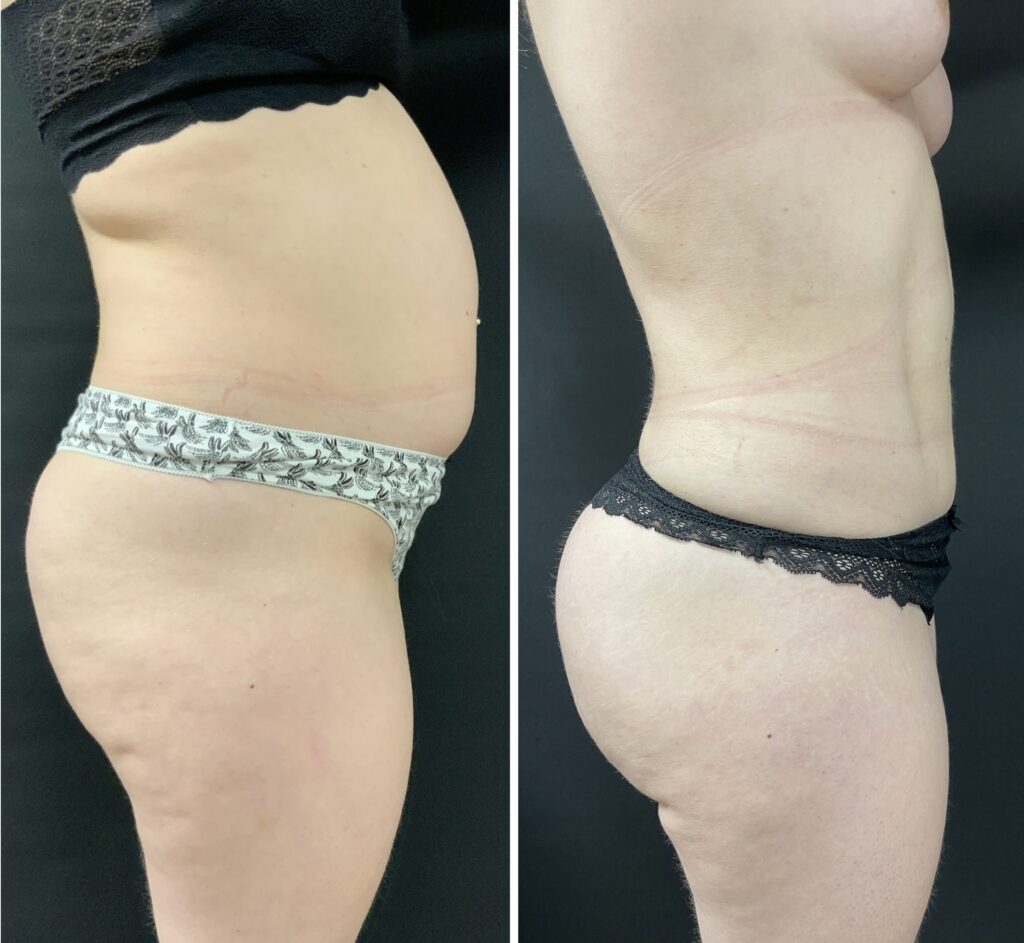
Renuvion® is particularly indicated for clinical situations involving more pronounced skin laxity, larger body areas to be treated, or specific post-surgical scenarios.
Moderate to severe skin laxity
When skin laxity is moderate to severe, Renuvion® provides greater tissue contraction than Endolift® used as a monotherapy. Its ability to deliver intense thermal energy in a very short time, thanks to helium-assisted cooling, results in immediate contraction of collagen fibers. This property is particularly valuable in large areas of the body or those with significant laxity:
- Upper arms (non-surgical brachioplasty);
- Post-pregnancy or post-weight-loss abdomen;
- Inner thighs and front of the legs;
- The area under the chin and the neck, with marked laxity.
After significant weight loss
Massive weight loss is one of the primary indications for Renuvion®. Patients who have undergone bariatric surgery often have significant excess skin with marked laxity in many areas of the body. In these cases, Renuvion® allows for substantial skin retraction without the need for complete surgical excision. A study by Barone et al. observed improved body contouring and a statistically significant reduction in laxity in patients following massive weight loss who underwent abdominoplasty using Renuvion® in conjunction with liposuction.
After liposuction
The combination of Renuvion® and liposuction is a recognized synergistic approach in body contouring surgery. After the removal of fat deposits, the skin may exhibit excess laxity that cannot be resolved by fat removal alone. The subcutaneous application of Renuvion® then addresses this residual laxity, complementing the liposuction procedure. A randomized controlled trial involving 176 patients undergoing arm contouring demonstrated comparable efficacy between RF-assisted liposuction, Renuvion® subcutaneous helium coagulation, and VASER-assisted liposuction alone—with 80.6% patient satisfaction and 97 out of 119 cases rated as good to excellent by an independent surgeon.
FAQ
What is the main difference between Endolift® and Renuvion®?
Endolift® uses a 1,470-nm diode laser to gradually stimulate collagen remodeling, while Renuvion® combines radiofrequency and helium plasma to induce immediate tissue contraction and neocollagenesis. These mechanisms are distinct but potentially complementary.
Can Endolift® and Renuvion® be combined in the same treatment plan?
Yes. A clinical case study published in 2026 evaluated this bimodal approach on upper arms with moderate laxity. The results showed a 34.3% reduction in circumference with the combination, compared to 28.8% with Renuvion® alone, with no adverse events. A one-week interval between the two treatments is recommended to minimize the risk of thermal overlap.
Which is more painful: Endolift® or Renuvion®?
Both procedures are performed under local anesthesia and are generally well tolerated. Endolift® is often described as slightly less uncomfortable. Renuvion® may require more extensive anesthesia depending on the area being treated. In both cases, postoperative redness and tenderness usually subside within 48 to 72 hours.
Are the results long-lasting?
No non-surgical cosmetic procedure guarantees permanent results, as the skin continues to age naturally. However, clinical data indicate that Renuvion® can produce lasting effects for up to 5 years in some cases. For Endolift®, the 6-month follow-up data are encouraging, but studies with longer follow-up periods are needed to determine long-term durability.
